Showing posts with label Vionnet. Show all posts

Thursday, September 2, 2010

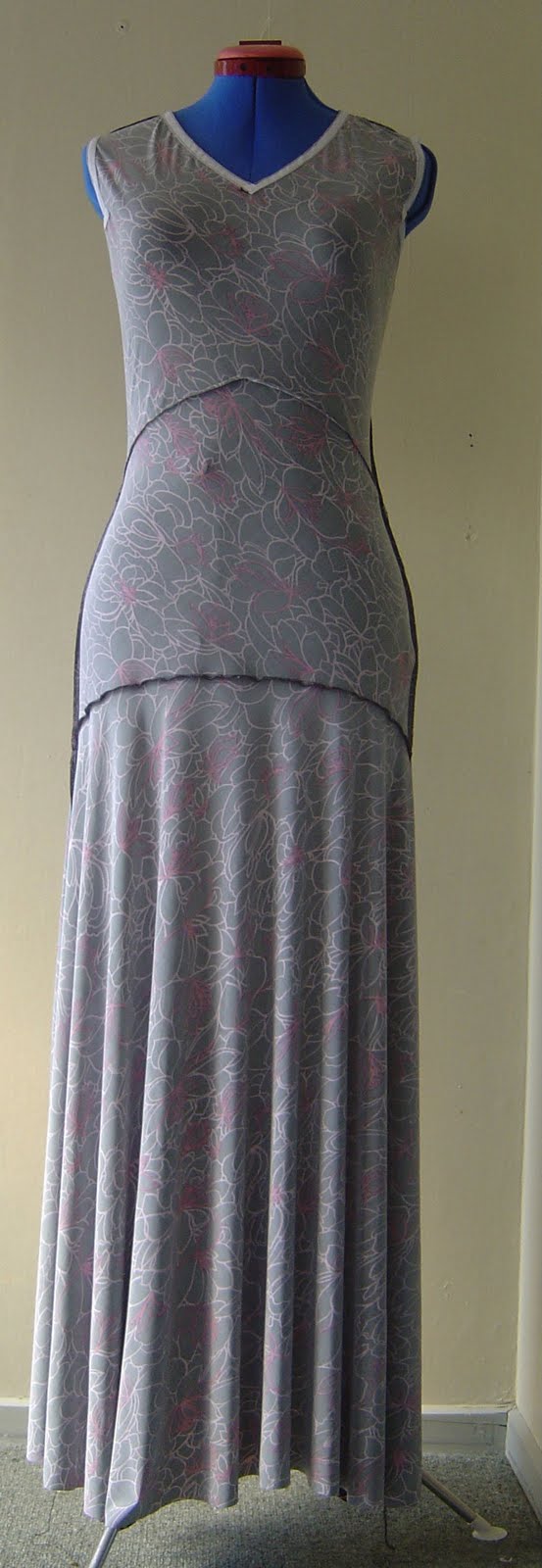
Vionnet dress - finished!

I don't like how I look in these photos, (when do I ever?) but I'm so pleased with the dress that I couldn't wait to show it off and couldn't wait for David to get home and take nice pictures (he makes me smile) and wanted to show it on me rather than the dummy - you get a much better idea of how it looks in real life. (Phew - need a breath after that sentence).

So here we go - angled view of the front:
And the back:

These shoes are not what I would likely wear with this dress, but they were the first heels I grabbed when getting organized to take the photos. And despite appearances to the contrary I am quite vain enough to want to make my legs look the best that I can. Which means heels.

I'm not wearing sucky-in undergarments (great suggestion Ann) because I don't own any. I've always worked on the theory that anything requiring such things was going to be too much work to wear! I may revisit this opinion, but this doesn't look too bad. I have several convertible bras which are ideal - just cross the straps at the back and we're good to go.

The hem I ended up just cutting. To stop the overlocked seams unravelling I would normally just stitch over the end, but given my sewing machine's dislike for this I decided to deal with the ends by threading them back through the seam. To have an end to thread after cutting the hem I left the seamlines uncut when I cut the hem, then unpicked the overlocking on the dangling seamlines, cut off the excess fabric, knotted the threads and threaded them through the seam.

My parents visited yesterday and were fascinated by the dress - especially my Dad, who is a retired structural engineer. He had a great appreciation for the dress' evolution from scaled schematic (with no indication given of what scale!) to dress. It is from him that I inherited my love of this sort of problem solving.


Now of course I want to WEAR it! Spring sprang yesterday with a gloriously bright sunny day so today is of course grey and overcast.
I'm not sure what's next. I have a large stack of possiblities from the Kirke book, or approximately seven kersquillion (yeah it is so a number!) other dresses that I'd like to make. With the twins weaned just after they turned two I will never breastfeed again (sad and not sad about that) so I can wear dresses whenever I want.


I'm linking to No Big Dill's sewing month challenge - to do something new. When I first read about it I struggled to think of something I hadn't done before - wedding dress(es)? yes. Design and pattern making? yes. Canvas boat cover (with clear plastic zipped door)? yes. Menswear? yes. Historical costumes? yes. Velvet, silk, wool, lace etc etc? yes. Then I realised that I have never made a dress for myself to wear from a pattern schematic of a design by Madeleine Vionnet (one of my design idols). So there's my first!

Friday, August 27, 2010

Vionnet dress - almost there

I had this dress cut out and sitting in a bag on my desk for quite a while because when I sewed the waist dart on the front I realised that this is one of those fabrics which my sewing machine haaaaaaaaaaates. It has a rubbery feel to the stretch and is what I call pin resistant - it's hard to push a pin through. The overlocker loves it, and it is heavy and drapey - perfect for a dress of this style, so I was going to persevere. Unfortunately the busy print pretty much renders the interesting seaming invisible. Fortunately it hides the hole I cut right at the CF when I trimmed away the excess facing strips from the neckline. (Yes I swore as I sewed it up.)

Oh, and it clings to every little bump. The bumps you can see on the hip are the adjusting knobs on the dummy. I don't have adjusting knobs, but I do have my own collection of bumps.

Inside out you can see much better how it's put together.


I love how it falls in such perfect graceful folds. I really don't love how hard it was to finish the neck and armholes. My first plan was to use a self facing. My attempts to sew this using my machine looked terrible, even with a brand new stretch needle and a walking foot, even using my usually fool proof press'n'seal stabilizer method. I tried using a narrow three thread overlock, but that lettuced out (first time in 20 years I wished my machine had a differential feed). Hand rolling (on a sample) also looked awful. Lying in bed stewing over it and describing my problems (at length and in detail) to my long suffering husband made me feel better but didn't produce an answer. Stewing about it some more after he went to sleep (sensible man) made me wonder if bias strips of a woven fabric would work as facings. Vionnet used on grain strips of self fabric to do this, but with my very stretchy fabric I thought bias would be better. And what do you know - perfect solution. The woven fabric stopped all the skipped stitches and finishes the edges perfectly. I still need to press the edges, but trust me, they sit very nicely against me.


So this is going to be a wearable dress. I'm going to leave it on the dummy for a couple of days to let the bias hang (yeah, I cut this very stretchy knit with a fantastic degree of recovery on the bias. Just for the hell of it), but I don't expect a whole lot of change. I'm thinking of hemming it longer to make the most of the swishy skirt. My first plan was just below the knee, but I think maybe longer would be better. Next problem - how the h*** am I going to sew the hem?

Thursday, August 5, 2010

Vionnet toile #2 on me

Between a temperamental computer and blogger being picky I figured that rather than edit my last post to add these photos I'd just post again.

So here it is on me, now with seam allowances around the armholes cut away as well so this is the current toile's finished size. (And not only is my hair brushed, but I've also run the straighteners over it. Not for blogging pride I'm ashamed to admit, but because we're going to Georgia's intended Intermediate School's open night this evening. Out in public=tidy hair)


I am really really pleased with how it's looking. The "bubbling" of excess fabric over my hips and odd fall of the back skirt's side seams below this are almost certainly due to the uneven match of seams between waist and hip. Just to check I'll probably adjust this toile and press the seams. As it is it makes my butt look huuuuuuge. (So we all know it'll be fixed in the final garment!)
It isn't perfectly flat across my lower back, but a more drapey or stretchy fabric may address this. I still can't get over the fact that such a fitted dress fits over my head with no opening. What a perfect dress.
Any suggestions/opinions very welcome.

Vionnet toile #2

Ta DAAAAAAA!
Front:
Back:
A couple of quick notes - I've cut away the seam allowances on the neckline, so this is the finished neck size, but I haven't trimmed away the armholes, so they will be 2.5cm smaller. The skirt is just portions of the total, cut on the correct grain, incorporating all of the seams but not all of the length, to save fabric and time. (I actually quite like it!) And it isn't pressed at all.
I can't believe it only took two toiles to get it to fit! (It helps that I'm not wildly different in size to the original wearer.) I was so eager to get the alterations done that I forgot to photograph how I added in the extra. I'll explain as best I can.
By measuring the sewn-up toile #1 I worked out that I had to add about 8cm to bust and waist. This is a very managable figure - 2cm each at CF, CB and side seams. Pretty straightforward - on a traditional pattern with side seams. I established where the sides were on my toile and marked that on the front pattern piece. Then I drew a line perpendicular to the CF onto the piece, making sure it went through the sticking out bit which contained the sides. I traced the stitcking out bit and slid the tracing 2cm along the perpendicular line, then blended the lines back to the original at the armhole and to an added 1.5cm along the hip bit I'd added to be safe, I figured I could always take it out) I just added 2cm to the CF. It'll lower the neckline, but since it's quite high that won't be a problem. To the back I added 2cm to the CB by tracing the original toile right down to where it curves in at the bottom. There I pivoted so that the original lowest point (at the CB) was on the new moved CB line. That just meant that I hadn't changed the length of this section and wouldn't need to alter the corresponding skirt piece. It's such a small amount I've changed the angle that I'm not worried that it'll affect the drape of the skirt hanging from that seam in any noticable way. I didn't have to touch the back skirt pieces, and the front skirt is a simple quarter circle with a right angled triangle cut off the top. Since I'd altered the section to be joined to the front skirt I worked out how much to cut off by measuring the lower bodice edge and applying pythagoras. I wish my kids had been around at the time so that I could have lectured them sanctimoniously on how useful mathematical theory is in the real world.
A bit of feverish haste to sew and slip it over the dummy and it FIT! Just like that! So I tried it on me. To my complete and utter astonishment, it fit me too! Now this is a relatively fitted dress with no fastenings - the stretchy nature of bias is what enables you to get it on and off. M Vionnet was one very clever lady. It's tight across the bust but otherwise damn near perfect. I was twisting and turning to see the back in a tiny wall mounted mirror but David said that when I stood still the back was perfectly flat. So I drafted and cut out sections of the skirt, just to get a feel for how it looks all together. There is only one area that needs tweaking, where I've altered the length of one bodice section and need to compensate on the skirt. You can see on the front that the lowest portion of the bodice is a bit puffy. Easy fix! I tried it on when I'd attached the skirt and couldn't believe how well it fits on only toile #2. I'll try a self-timer shot on me when the twins go to bed.


So that's whereI'm at. So very nearly there, with way fewer headaches than anticipated. I'm inclined to think that I've learned all I'm going to from the lining toiles, and since fabric choice is crucial it's not worth doing any further testing and tweaking till I know what I'm going to use. I have about 8m of a knit I got because if you bought the whole roll you got it for next to nothing. Curiosity might drive me to try a toile in that, just to see how it works. Who am I kidding? Expect toile #3 in a knit next!
I'm having so much fun with this project! I was browsing some of my historical reference books the other night, including this beautiful two volume set of drool inducing eye candy. And there in Vol II, p460 is my dress! In black silk. I wish they'd included a picture of the back, but at least it's a picture. Also I hit Google to see if I could get any help with the project and found this article from Threads written by Betty Kirke herself. She explains how she measured the garments to produce the patterns - fascinating!
And Sherry I had to laugh when you commented that you were suddenly bored with your project and wanted to spend an afternoon here - that was pretty much my reaction when I saw the wedding dress you posted - I'd love to spend an afternoon exploring your stuff! (And watching you do bound buttonholes. That'd be good too.)
Edited to add - Arrgh!!!! Blogger won't let me break up my text into paragraphs! Sorry, this is a massive chunk of unbroken text to read. What's their problem with spaces anyway?

Tuesday, August 3, 2010

Vionnet toile #1

And so it begins....

I made up just the top portion of the Vionnet dress to see how I'm going scale wise. It's cut on the correct (bias, naturally) grain, of lining. And when I tried to slip it onto my dummy it was immediately obvious that it wasn't going to fit. After ripping out the "side" seams I slipped it on and had a look.

You can just make out my stitching lines in white (I marked those with dressmakers carbon before I took the paper pattern pieces off). I didn't pin it terribly evenly so one side gapes more than the other.


It's close enough that I think my scaling is pretty close - it's just a tiny dress! It's also meant to be made from very drapey satin, which would make it looser than my lining.
So, my next problem is how and how much to scale up? My first thought is that with complex and unconventional seaming it would be easier to just enlarge the whole thing by using a larger scale than by any type of grading technique. The problem with that is that it'll make the bodice longer as well as wider, which obviously wouldn't work. So I'm going to do some measuring to see how much extra width I need and see if I can add that in without ruining the lines of the dress. I can sneak a bit in at CF and CB, the rest is going to take some careful thought. The skirt is so full that I feel I can ignore it at this point. It's also so simple that it can be easily adjusted to match anything I do to the bodice without compromising the cut. And Sherry, yes it is slashed at the CB to match the point of the bodice CB. Can't wait to see how that looks!

Monday, August 2, 2010

Up Next

So I went to the library yesterday, and whilst browsing the shelves I spotted the famous Vionnet book by Betty Kirke. I've wanted this book ever since I knew it existed, but as is always the way, cost is prohibitive. So to see it sitting on my library shelves seriously made my heart start to flutter! Sadly it had a "Not For Issue" sticker on the front cover, but it did not have a "Do Not Pick Three Garment Schematics To Photocopy" sticker, so I raced away to the photocopier and cleared out the change in my wallet, grateful that (most unusually) I had change in my wallet! I photocopied the sketch and pattern schematics for three designs, with plans to go back and have a proper look at the book when I don't have Georgia downstairs picking her own books and wondering what Mum's doing upstairs for so long!

I seem to be suffering a serious case of winter blahs this year and I've decided that a Vionnet dress is the perfect antidote. Even recreating the pattern presents all sorts of challenges. Just what my brain needs.

I remembered a post on Kathleen Fassanella's blog, Fashion Incubator, about the Kirke book and a Japanese companion book which is better for reproducing the patterns. So I knew before I even saw the Kirke book that there are likely to be some challenges turning the pattern schematics into patterns. For my own entertainment I'm going to blog this process, and maybe I'll learn something of use to others who want to do the same thing!

I'm going to start with this dress, pattern #14. Isn't it beautiful? I'll shorten the skirt and I'd like to make it from something I can wear as an every day summer dress, but I'll see where the pattern leads me.

First problem - there is no scale indicated to enlarge the pattterns. Crap. (I did know this beforehand) There are no landmarks such as "waist" helpfully marked to help gauge scale. I made a fairly educated guess that it was 1-10 scale, based on estimating where the waist would fall on the pattern, and working out that the back neck to waist measurement was about 4cm, and the measurement on a person is about 40cm. Very dodgy estimation, but I would guess that it would be a round number scale - not 1-12.34 for example. After I'd decided this I found a message board thread (which I didn't mark, annoyingly, so I can't find it again!) in which someone mentioned using a 1-10 scale for these patterns. She didn't say it hadn't worked, so I'm going to stick with it.

So now I needed to scale up with no grid. It was actually quite easy to transfer the schematics to a grid - I just traced them onto a 5mm grid torn from an old maths book. Then I took a large sheet of paper and folded it into a 5cm grid to get my 1-10 scale. I folded rather than drew because it was less prone to errors (as a pencil blunts the lead gets thicker, and further from the ruler etc etc). Also I then have my grid visible on both sides of the paper and I can rub things out without losing the grid.

Not my favourite method to reproduce something, but with great care and careful measuring (I think I used every measuring tool I own) I could recreate the pattern pieces.


Traced onto plain paper and with 2.5cm seam allowances added, here's the result of about 2 hours work today.

At this point I ground to a halt because my dummy and the fabric I'm going to try first are in the bedroom where the twins are napping. For my first toile I'm going to use lining because it's lightweight and I have a lot of it. I know it's not nearly drapey enough, but it should give me an idea of how it's going size wise. Tomorrow.....